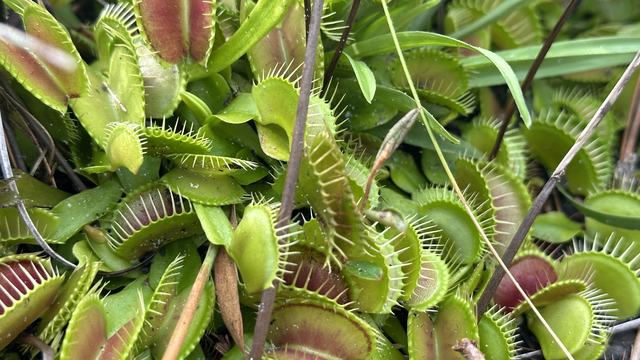
If you've ever grown a Venus flytrap and watched in horror as it turned black and shriveled up come November, you're not alone. Here's the good news: it probably hasn't. It's entering a dormancy period, what Venus flytraps have done for thousands of years in the longleaf pine savannas of southeastern North Carolina.
The Venus flytrap (Dionaea muscipula) is a species endemic to the Southeastern Carolinas. You'll find wild populations only within about 70 miles of Wilmington, growing in the wet, sandy, nutrient-poor soils of our coastal plain. This isn't a tropical plant from some steamy jungle, despite what many people assume. It's a temperate perennial that experiences real winters, frost, freezing rain, and all.
Like other perennials native to our region, Venus flytraps go dormant when winter arrives. The above-ground parts die back, but the plant survives underground in its rhizome, a bulb-like structure that stores energy until spring.
Catching insects comes at a biological cost. Research has shown that when a Venus flytrap snaps shut on prey, photosynthesis in that trap temporarily decreases while respiration increases. This means the plant spends energy to catch and digest its meal. Over a growing season of catching dozens of insects, producing new traps, and potentially flowering, the plant draws heavily on its resources.
Dormancy gives the plant a chance to rest and rebuild. During this period, the rhizome stores starch reserves, a finding confirmed by researchers who noted that these high starch reserves allow Venus flytraps to rapidly resprout after fires sweep through their native habitat (Gao et al., 2015). The same stored energy that helps wild plants recover from fire also fuels the burst of spring growth that gardeners look forward to each year.
Two environmental cues trigger dormancy. The primary signal is photoperiod, also known as the day length. As autumn days shorten, the plant senses the change and begins shifting from active growth to energy storage. Temperature plays a supporting role, with cooler conditions (roughly 35–50°F) reinforcing the dormancy signal. In the wild, dormancy typically runs from November through early spring, lasting three to five months depending on weather conditions.
The Indoor Plant Question
If you're growing a Venus flytrap indoors under artificial lights or in a bright window, does it still need a dormancy period?
According to the International Carnivorous Plant Society, the answer is no, not necessarily. Their cultivation guide states that Venus flytraps grown continuously indoors under adequate artificial lighting will "grow continuously and look nice indoors as long as they get enough light and are fed regularly." The New York Botanical Garden's care guide agrees, noting that indoor Venus flytraps "do not need to enter dormancy when grown indoors, though it can be grown with a dormancy period in the winter that may benefit the plant."
The key word here is adequate. We're not talking about a plant sitting on a dim windowsill. The ICPS recommends 15,000 to 25,000 lux of LED lighting for roughly 14 hours daily, significantly more light than most houseplants require. Plants must also be fed regularly to compensate for continuous growth indoors.
For most home growers, providing this level of light year-round isn't practical. And plants that experience natural seasonal light changes, whether outdoors or on a windowsill, will enter dormancy on their own. Trying to force such plants to keep growing through winter usually results in weak, stressed specimens.
Professional growers note that while you can skip dormancy once or twice without killing the plant, doing so repeatedly leads to decline. Plants become less vigorous, more susceptible to disease, and may exhaust themselves by flowering at the wrong time.
Practical Recommendations
If your Venus flytrap grows outdoors:
Let nature take its course. As days shorten and temperatures drop, the plant will enter dormancy naturally. Keep the soil moist but not waterlogged, and protect from hard freezes below about 20°F. Don't bring the plant inside to "save" it, you'd be interrupting a process the plant needs.
If your plant grows on a windowsill: Expect dormancy to happen due to reduced winter light. You can allow this natural rest period, or supplement with grow lights if you want to keep the plant active. Consistency matters most, don't switch back and forth.
If you grow under dedicated grow lights year-round: You have the option to skip dormancy entirely, provided you maintain strong light (14+ hours daily) and feed the plant regularly. Many serious collectors do this successfully.
Minimum dormancy period: If you do provide dormancy, aim for at least 10 weeks at temperatures between 35–50°F. Some growers keep plants dormant for three to five months without issue.
Venus flytraps evolved dormancy as a survival strategy for the mild but real winters of coastal Carolina. The rest period allows them to store energy, synchronize growth with favorable seasons, and prepare for spring reproduction. While indoor growers under controlled conditions can successfully bypass dormancy, most home growers will find it easier, and better for the plant, to let this natural cycle happen.
References
- California Carnivores. (n.d.). Venus flytrap (Dionaea muscipula) growing tips.https://www.californiacarnivores.com/blogs/growing-tips/76001413-venus-flytrap-dionaea-muscipula-growing-tips
- Gao, J., Ebert, D., Ren, G., Chen, Q., Lindberg, S., & Schubert, S. (2015). Integration of trap- and root-derived nitrogen nutrition of carnivorous Dionaea muscipula. New Phytologist, 205(3), 1320–1329. https://nph.onlinelibrary.wiley.com/doi/full/10.1111/nph.13120
- Grow Carnivorous Plants. (n.d.). Grow Venus flytrap. https://www.growcarnivorousplants.com/venus-flytrap-care/
- International Carnivorous Plant Society. (2019). Growing Dionaea muscipula (Venus flytrap). https://www.carnivorousplants.org/grow/guides/Dionaea
- New York Botanical Garden. (n.d.). Venus flytrap houseplants – Carnivorous plant care. https://libguides.nybg.org/c.php?g=654975&p=4597429
- Pavlovič, A., Demko, V., & Hudák, J. (2010). Trap closure and prey retention in Venus flytrap temporarily reduces photosynthesis and stimulates respiration. Annals of Botany, 105(1), 37–44. https://pmc.ncbi.nlm.nih.gov/articles/PMC2794070/